
How to Stop Procrastinating (Starting With a Monkey and a Monster)

how to stop procrastinating weekly check in

Tim Urban, who writes the blog Wait But Why, once had a full year to write his college senior thesis. Ninety pages, plenty of time, no excuse to rush. He didn’t write a single word for months. Then, with three days left before the deadline, something he later called “the funniest thing” happened. He wrote all ninety pages in seventy two hours, pulling two consecutive all-nighters, something he noted afterward that humans really aren’t built to do.

Urban turned that experience into one of the most watched TED talks ever given, and the explanation he came up with is more useful than most procrastination advice out there. He describes a Rational Decision-Maker in everyone’s brain, the part that plans ahead and wants to do the responsible thing. But a procrastinator’s brain also has an Instant Gratification Monkey, which, in his words, “does not seem like a guy you want behind the wheel. He lives entirely in the present moment. He has no memory of the past, no knowledge of the future.” Left in charge, the Monkey drags you toward whatever’s easy and fun right now, deep into what Urban calls “the dark playground,” leisure enjoyed while knowing you should be working, which somehow manages to not even feel like real fun.

There’s only one thing the Monkey is afraid of: the Panic Monster, who wakes up when a deadline gets close enough to feel genuinely threatening, scares the Monkey off, and lets the Rational Decision-Maker finally take back control. As Urban put it, “the procrastinator has both a guardian angel and a demon, and the demon is winning most of the time.”

Here’s the part that matters most, and the part Urban himself only fully understood after the talk went viral and thousands of people wrote to him. This system works fine when a real deadline exists to summon the Panic Monster. It falls apart completely for the goals in your life that don’t have one.

Why the Panic Monster Isn’t Actually a Solution
how to stop procrastinating panic monster

Relying on last minute panic feels like it works, but it only works for a specific kind of task.

  • Deadline driven procrastination is contained, since the Panic Monster eventually shows up and forces action before real damage is done
  • The dangerous version has no deadline at all, exercising more, starting a business, writing a book nobody assigned you, so the Panic Monster never wakes up
  • Urban has said this second kind can let procrastination continue indefinitely, sometimes for years, without ever forcing a resolution
  • If you’re only ever relying on panic to get moving, you’re unprotected on exactly the goals that matter most to you long term

Give Yourself a Deadline Where None Exists

Since the Panic Monster only responds to real pressure, the fix for undeadlined goals is manufacturing something close to it.

  • Set a specific date for a goal that currently has none, and tell someone else about it so there’s real accountability behind it
  • Break a large, vague goal into smaller deadlines spaced weeks apart, rather than one distant, easy to ignore end point
  • Attach a real consequence to a missed deadline, even a small one, so it carries some actual weight
  • Revisit and adjust these self imposed deadlines honestly rather than quietly moving them every time they arrive

Shrink the Task Until the Monkey Stops Objecting

how to stop procrastinating shrink the task

A lot of procrastination isn’t about the whole task, it’s a reaction to how large and undefined it feels in the moment.

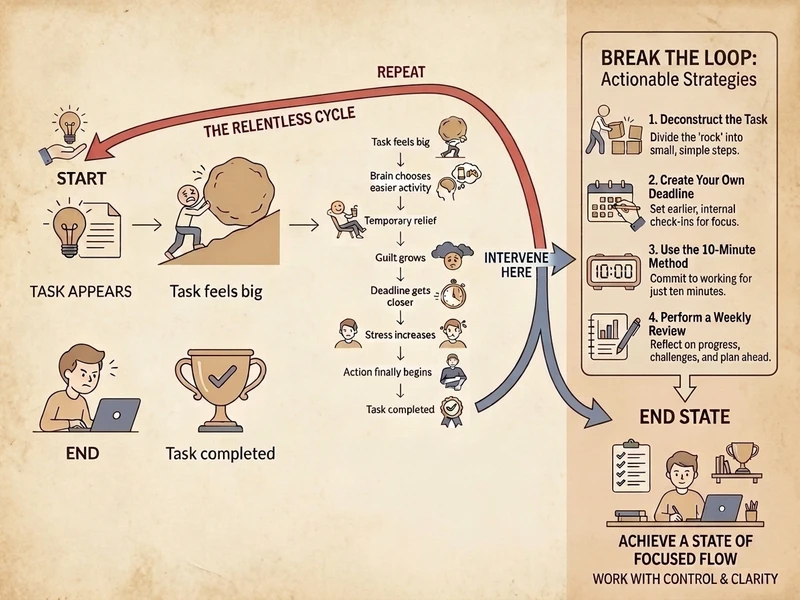
  • Break the task into a piece so small it feels almost impossible to avoid starting
  • Commit to just ten minutes of work rather than framing it as an entire session you have to complete
  • Notice that starting is usually the hardest part, and that momentum tends to build naturally once you’re a few minutes in
  • If you’re still avoiding it, the piece is probably still too big, and needs to be broken down further

Recognize the Dark Playground for What It Is

Urban’s term for procrastination’s leisure activities is useful because it names something people rarely notice in the moment.

  • Notice when you’re doing something enjoyable specifically because you’re avoiding something else, not because you actually chose to relax
  • This kind of leisure tends to feel hollow rather than restful, since part of your mind is aware of what you’re avoiding the whole time
  • If you want a real break, take it deliberately, after deciding to pause, not as an escape from a task you haven’t started
  • Naming the pattern out loud, even just to yourself, tends to make it easier to step out of

Address What’s Actually Underneath the Procrastination

procrastination quote

For some people, procrastination isn’t really about time management at all, and it helps to be honest about that.

  • Perfectionism often disguises itself as procrastination, since starting feels too risky if the result has to be flawless
  • Fear of a difficult or overwhelming outcome can make avoidance feel safer than starting and finding out
  • If procrastination feels constant and disproportionate to the task itself, it may be tied to something like anxiety, depression, or ADHD, worth discussing with a professional rather than solving through willpower alone
  • Treating the root cause, not just the symptom, tends to matter more than any single productivity trick

Build a Weekly Check-In With Your Undeadlined Goals

stop-procrastination

Since these are the goals most likely to quietly stall, they need deliberate, regular attention that a normal to do list won’t give them.

  • Set aside a few minutes weekly specifically to check on goals that have no external deadline pushing them forward
  • Ask honestly whether you’ve made any real progress, or whether the goal has quietly been sitting untouched
  • Adjust your self imposed deadlines and next steps based on that honest check-in, rather than letting the goal drift indefinitely
  • This single habit is often what separates a goal that eventually happens from one that gets mentioned for years without ever moving
  • The Procrastination Loop

    Most procrastination follows the same predictable cycle. A task feels big or uncomfortable, so the brain seeks something easier and more rewarding. Temporary relief follows, but so does guilt, making the task feel even heavier the next time you see it. As the deadline approaches, urgency finally overrides avoidance, leading to rushed work and reinforcing the belief that “I work best under pressure.” Breaking this loop doesn’t require more motivation—it requires interrupting it early with a small first step before panic becomes the only trigger.

FAQ: How to Stop Procrastinating

Generally something else. Tim Urban’s framework describes it as a conflict between a Rational Decision-Maker and an Instant Gratification Monkey pulling toward whatever feels easy right now, not a simple lack of effort or care.

This is what Urban calls the Panic Monster effect, a genuine sense of urgency that finally overrides the pull toward distraction. It works, but only for tasks that actually have a deadline attached.

Manufacture one. Set a specific date, tell someone else about it for accountability, and break the goal into smaller deadlines along the way, since without any of that, there’s nothing to eventually trigger action.

For some people, yes. Chronic, disproportionate procrastination is often linked to underlying patterns like perfectionism, anxiety, or ADHD, and addressing that underlying pattern, sometimes with professional support, tends to matter more than productivity tricks alone.

Tim Urban didn’t stop procrastinating by trying harder. He got specific about what was actually happening in his head, and built his approach around that instead of just feeling guilty about it. The same shift helps most people, name the pattern, manufacture the deadline your important goals don’t already have, and stop waiting for panic to be your only way forward.

Similar Posts

Leave a Reply

Your email address will not be published. Required fields are marked *