
Daily Routine for a Productive Day (Franklin’s Actual Schedule)

daily routine productive day featured

In his autobiography, Benjamin Franklin included something most historical figures never bothered to write down, his actual daily schedule, hour by hour. Not a philosophy of productivity, an actual timetable. Rise at five. Wash, and address a moment of reflection. Plan the day’s business. Work from eight until noon. A midday break to eat and read. Work again from two until six. Evening spent putting things back in their place, supper, conversation, and a review of the day. Sleep at ten.

What makes it worth studying isn’t the schedule’s rigidity, it’s the two questions bookending it. Each morning, before starting his plan for the day, Franklin asked himself, “What good shall I do this day?” Each evening, closing the same page, he asked, “What good have I done today?” Between those two questions sat the actual work of the day, structured into a small number of large, protected blocks rather than a scattered list of tasks.

Franklin printed newspapers, ran a postal service, invented the lightning rod, founded a university, played multiple instruments, and helped draft the founding documents of a country, all within one lifetime. His schedule wasn’t complicated. It was just consistent, intentional, and built around a question he was willing to actually sit with twice a day. That’s a more useful model for a productive day than most modern advice offers.

The Actual Shape of Franklin’s Day

daily routine productive day shape of day

Before adapting anything, it helps to see the real structure he worked from.

  • Five to seven in the morning: rise, wash, a moment of reflection, plan the day’s business, breakfast
  • Eight to noon: focused, uninterrupted work
  • Noon to two: a break to eat and read
  • Two to six: a second block of focused work
  • Six to ten in the evening: put things away, supper, conversation or music, review of the day
  • Ten to five: sleep, a full seven hours, generous for his era and reasonable by modern standards too

Start the Day With a Real Question, Not Just a Task List
daily routine productive day morning question

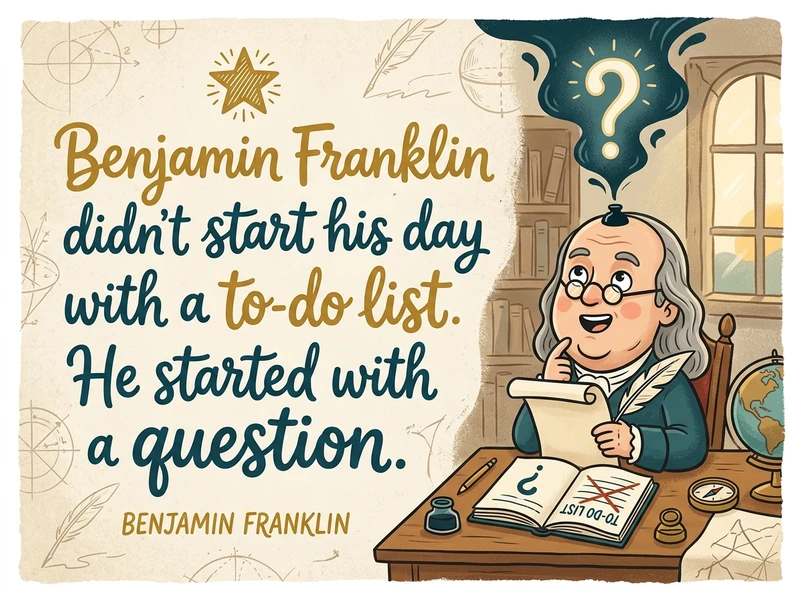
Franklin’s morning question did more work than a typical to do list, and it’s worth borrowing directly.

  • Before opening your task list, ask yourself something closer to Franklin’s own question, what would actually make today worthwhile
  • This shifts the day’s starting point from a list of obligations to an actual intention, which tends to change how the rest of the day gets prioritized
  • Write your answer down, even briefly, rather than letting it stay a vague thought
  • Let this question set the tone before checking email, messages, or anything else that isn’t yours to decide

Work in Large, Protected Blocks Instead of Scattered Tasks
daily routine productive day protected blocks

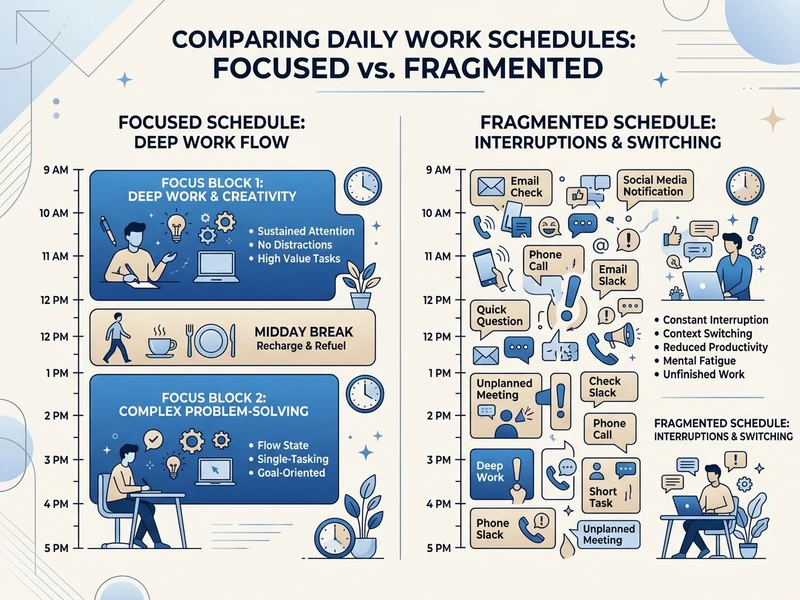
Franklin’s schedule has only two real work blocks, each four hours long, which is strikingly different from how most modern days actually unfold.

  • Protect large stretches of time for focused work rather than fragmenting the day into short bursts interrupted by other demands
  • Two clearly defined blocks, separated by a real break, tend to produce more meaningful output than a day scattered with constant task switching
  • Treat the boundaries of these blocks seriously, the same way Franklin appears to have treated his own schedule with real consistency
  • If four hour blocks aren’t realistic for your life, the principle still holds at a smaller scale, fewer, longer blocks beat many short, interrupted ones

Build in a Real Midday Break, Not Just a Quick Bite

daily routine productive day midday break

Franklin’s schedule includes a genuine two hour break in the middle of the day, used for eating and reading, not just refueling quickly.

  • Step fully away from work during a midday break rather than eating at your desk while continuing to work
  • Use part of the break for something unrelated to work entirely, reading, a walk, a real conversation
  • Treat this break as functional, not indulgent, since it separates the day into two distinct, more focused halves
  • A longer, more complete break in the middle of the day tends to support more focused effort afterward, not less

End the Day With Genuine Reflection, Not Just a Shutdown

daily routine productive day evening reflection

Franklin’s evening question, closing the loop on his morning one, is the part most modern routines skip entirely.

  • Ask yourself directly what you actually accomplished or contributed today, rather than letting the day simply end unexamined
  • This isn’t about self criticism, Franklin’s own version was closer to honest accounting than harsh judgment
  • Use this reflection to inform tomorrow’s morning question, creating a loop rather than two disconnected moments
  • Close the day with something restorative, as Franklin did with supper and conversation, rather than letting work bleed into the evening indefinitely

Adapt the Structure Without Losing the Principle

Franklin’s exact hours don’t need to be copied precisely for the underlying approach to still work.

  • The specific schedule was built for an 18th century printer’s life, adjust the timing to fit your own, not his, working hours
  • What matters is the shape, a real morning intention, protected blocks of work, a genuine midday break, an honest evening review
  • Consistency mattered more to Franklin’s results than any single time block, keep whatever version you build steady enough to actually become routine
  • A rigid schedule that gets abandoned within a week is less useful than a simpler one you can actually sustain
  • The Two Questions That Bookended Franklin’s Every Day

    In his own autobiography, Benjamin Franklin documented the exact schedule that structured his days, rising at five, two separate four hour blocks of focused work, a full midday break, and an evening spent reviewing what had actually happened. He opened each morning with a direct question, “What good shall I do this day?” and closed each evening with its counterpart, “What good have I done today?” It wasn’t a philosophy of productivity so much as an actual, lived habit, one he returned to daily for years, and one that historians still point to when trying to explain how a single person accomplished as much as he did.

FAQ: Daily Routine for a Productive Day

The exact hours were built around his own 18th century printing business, but the underlying structure, a morning intention, two protected work blocks, a real midday break, and an evening review, adapts well to a modern schedule with different specific timing.

The two bookend questions, asking what good you intend to do at the start of the day and reflecting on what you actually did at the end, tend to be the most transferable and impactful part, more so than the exact hourly structure.

Franklin used two four hour blocks, but the specific length matters less than the principle, fewer, longer, protected blocks of focused work tend to outperform a day fragmented into many short, interrupted tasks.

No. The early wake time was specific to Franklin’s own life and era. The structure and intentionality of his routine matter far more than replicating his exact wake time.

Benjamin Franklin’s daily routine wasn’t complicated, and that’s exactly the point. A real question each morning, protected blocks of focused work, an actual break in the middle of the day, and an honest look back each evening. Nothing about that requires 18th century discipline to copy, it just requires deciding, the way he apparently did every single day, what would actually make today worthwhile before letting the day decide that for you.
Similar Posts

Leave a Reply

Your email address will not be published. Required fields are marked *