
The Eisenhower Matrix Explained (The Real Story, Not the Simplified One)
eisenhower matrix explained featured

On August 19, 1954, Dwight D. Eisenhower stood in front of the Second Assembly of the World Council of Churches in Evanston, Illinois, and said something that would eventually become one of the most repeated ideas in productivity culture. “I have two kinds of problems,” he told the crowd, “the urgent and the important. The urgent are not important, and the important are never urgent.”

Here’s the part almost every article about this quote leaves out. Eisenhower wasn’t claiming the idea as his own. He introduced it by crediting an unnamed former college president, widely believed to be Dr. J. Roscoe Miller, then president of Northwestern University. And Eisenhower himself never built a four box matrix out of it either. That came more than three decades later, when Stephen Covey included it in The 7 Habits of Highly Effective People and formalized it into the two by two grid now known as the Eisenhower Matrix.

None of this makes the tool any less useful. If anything, the real story makes it more interesting. A five star general and eventual president, someone who spent decades making decisions under genuine, high stakes pressure, found this distinction important enough to repeat publicly, and someone else later turned that single observation into a framework millions of people now use to sort an ordinary to do list. Here’s how it actually works.

The Real Distinction Behind the Whole Idea

eisenhower matrix explained real distinction

Before the grid itself, it helps to sit with the actual insight Eisenhower was pointing to.

  • Urgent tasks demand immediate attention, but they’re often driven by someone else’s priorities, not your own
  • Important tasks move you toward your actual goals, but rarely come with a deadline forcing you to act
  • Left unmanaged, urgent tasks will always crowd out important ones, simply because urgency creates pressure and importance usually doesn’t
  • The entire matrix exists to force a conscious choice between the two, instead of letting urgency win by default

The Four Quadrants, Explained Plainly

eisenhower matrix explained four quadrants

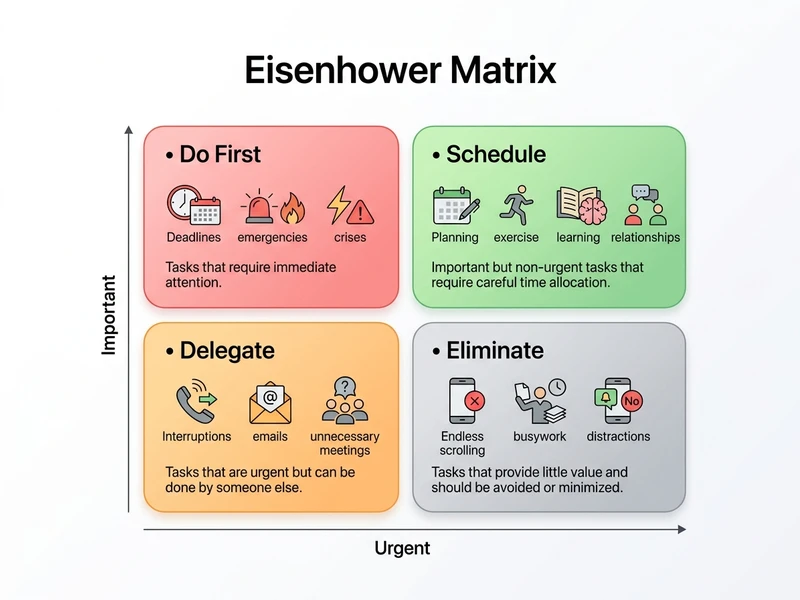
Stephen Covey’s four box version takes Eisenhower’s original observation and turns it into something you can actually sort a task list with.

  • Quadrant one: urgent and important, real crises, hard deadlines, genuine emergencies that need immediate action
  • Quadrant two: important but not urgent, planning, relationship building, skill development, the work that actually moves your goals forward
  • Quadrant three: urgent but not important, most interruptions and other people’s requests, things that feel pressing but don’t serve your actual priorities
  • Quadrant four: neither urgent nor important, low value distractions worth minimizing or cutting entirely

Why Quadrant Two Is Where the Real Leverage Lives

eisenhower matrix explained quadrant two leverage

Most people spend far more time reacting to quadrant one and three than they realize, while quadrant two quietly gets neglected.

  • Quadrant two work, planning, prevention, learning, relationships, rarely announces itself as urgent, so it’s the easiest category to keep postponing
  • Neglecting quadrant two tends to create more quadrant one emergencies later, since unresolved planning eventually becomes an urgent crisis
  • Deliberately scheduling quadrant two work, rather than waiting for free time to appear, is often the single biggest shift in how productive a week actually feels
  • Ask weekly where your quadrant two time actually went, since it’s the category most likely to get quietly skipped

Why Quadrant Three Is the Most Dangerous One

Quadrant three tasks are deceptive because they feel identical to quadrant one in the moment.

  • Urgency creates a physical sense of pressure regardless of whether the task actually matters to your goals
  • Many quadrant three tasks come from other people’s requests, meetings, or interruptions rather than your own priorities
  • Ask directly whether a pressing task is actually important to you, or just urgent to someone else
  • Where possible, delegate or decline quadrant three tasks rather than treating them with the same urgency as a genuine crisis

How to Actually Sort Your Own Task List
eisenhower matrix explained sort your list

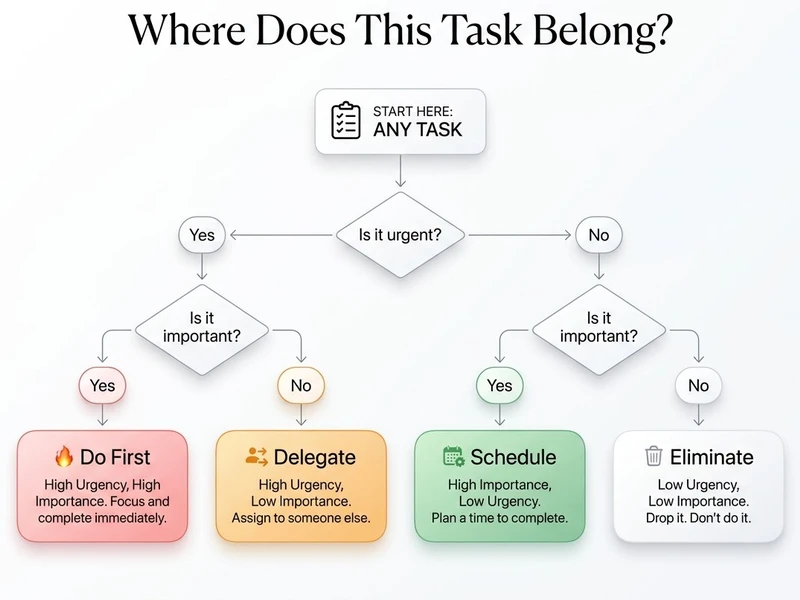
Applying the matrix in practice is simpler than it sounds once you have the four categories clear.

  • List out everything currently on your plate without sorting it yet
  • Go through each task and ask two separate questions, is this urgent, and separately, is this actually important to my real goals
  • Place each task into one of the four quadrants based on your honest answers, not how the task feels in the moment
  • Prioritize quadrant one first out of necessity, but deliberately schedule real time for quadrant two, since it won’t get done on its own

Use It Weekly, Not Just in the Moment

eisenhower matrix explained use it weekly

The matrix works best as a regular audit of where your time actually went, not only as a real-time sorting tool.

  • Set aside a few minutes weekly to look back honestly at how your time was actually spent across the four quadrants
  • Notice patterns, if quadrant three keeps dominating your week, that’s a sign to look at what you’re saying yes to
  • Adjust your coming week based on what the audit reveals, rather than repeating the same pattern automatically
  • Over time, the goal is shrinking quadrant three and quadrant four, and protecting more real time for quadrant two
  • The Biggest Mistake People Make With the Eisenhower Matrix

    Many people correctly sort their tasks into the four quadrants, then immediately spend the rest of the day responding to Quadrant One and Three because they feel urgent. The real power of the Eisenhower Matrix isn’t categorizing tasks—it’s intentionally protecting time for Quadrant Two. If your calendar has no dedicated space for important but non-urgent work, the matrix becomes an interesting exercise instead of a decision-making system.

FAQ: Eisenhower Matrix Explained

Not directly. He popularized the underlying urgent versus important distinction in a 1954 speech, crediting it to an unnamed former college president. The four quadrant matrix itself was created decades later by Stephen Covey in The 7 Habits of Highly Effective People.

Urgent tasks demand immediate attention, often driven by someone else’s deadline or request. Important tasks move you toward your actual goals, but rarely come with the same built-in pressure to act right away.

Quadrant two, important but not urgent work like planning and skill development, tends to offer the most long term leverage, even though it’s the easiest category to keep postponing since nothing forces you to act on it immediately.

It works well both as a real-time sorting tool for a busy day and as a weekly audit of how your time was actually spent, the second use tends to reveal patterns a single day’s list won’t show.

The Eisenhower Matrix carries the name of a man who never built it, quoting an idea he never claimed to invent. What actually matters isn’t the origin story’s tidiness, it’s the distinction underneath it, that urgency and importance are often two entirely different things, and the tasks quietly shaping your future rarely feel urgent enough to demand your attention on their own. Sort honestly, protect quadrant two, and let that distinction do the real work.


Similar Posts

Leave a Reply

Your email address will not be published. Required fields are marked *