
Journal Prompts for Emotional Awareness (Backed by Real Brain Research)

journal prompts emotional awareness featured

In 2007, UCLA neuroscientist Matthew Lieberman and his colleagues published a study in the journal Psychological Science that gave a real, measurable explanation for something people had long suspected worked, but couldn’t fully explain. Participants were shown photographs of faces expressing strong emotions while their brains were scanned. When they simply put the emotion into words, “angry,” “afraid,” the activity in their amygdala, the brain’s threat detection center, measurably decreased, while activity in the prefrontal cortex, the region responsible for reasoning and regulation, increased.

The finding has since been replicated across multiple studies and stimuli, real memories, anticipated stress, live stressors during the scan itself. The effect isn’t a light switch. Naming an emotion doesn’t make it disappear, the reduction in intensity is real but partial, not a cure. And it’s worth being precise about what this is and isn’t. Affect labeling, the technical term for this practice, is specifically a brief, precise act of naming, not the same as dwelling on or repeatedly analyzing a feeling. Researchers distinguish it clearly from rumination, which tends to have the opposite effect, keeping distress active rather than settling it.

That distinction is exactly why journaling is such a natural fit for this research. A journal entry that names what you’re actually feeling, specifically, briefly, honestly, is affect labeling in its most practical form. The prompts below are built around that same idea, helping you move from a vague, overwhelming feeling to something named and, according to the research, genuinely calmer to hold.

Why Naming a Feeling Actually Changes How It Feels
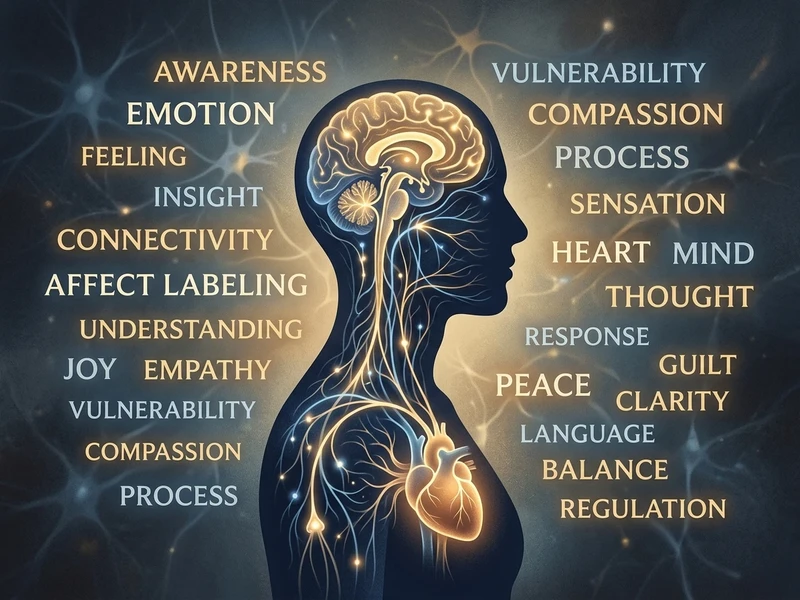
journal prompts emotional awareness why naming works

The mechanism behind this is worth understanding before using the prompts themselves.

  • Lieberman’s research found that labeling an emotion engages the brain’s reasoning centers, which appears to reduce activity in the brain’s threat response
  • This isn’t about suppressing or ignoring a feeling, it’s about giving the more rational part of your brain something concrete to work with
  • The effect is measurable but modest, naming an emotion reduces its intensity, it doesn’t erase it entirely
  • Precision matters more than eloquence, a specific, honest word tends to work better than a vague or overly poetic description

Prompts to Simply Name What You’re Feeling

journal prompts emotional awareness name the feeling

Start here, since precise naming is the actual mechanism the research points to.

  • What am I feeling right now, in one specific word, not just “good” or “bad”
  • If this feeling had a more precise name than the first word that came to mind, what would it be
  • Where do I notice this feeling in my body right now
  • Is this one feeling, or several feelings layered on top of each other
  • What’s the closest word I can find, even if it’s not perfect

Prompts to Explore Where the Feeling Came From

Once a feeling is named, understanding its source tends to make it easier to sit with.

  • What happened right before I started feeling this way
  • Is this feeling actually about what just happened, or something else it’s connected to
  • Have I felt this exact way before, and if so, when
  • What need of mine might this feeling be pointing to
  • Is there a pattern here I’ve noticed before but haven’t written down

Prompts for When a Feeling Feels Too Big to Name

journal prompts emotional awareness too big to name

Sometimes a feeling resists a single word, and these prompts help you get closer without forcing false clarity.

  • If I can’t find the exact word, what’s the closest approximation, even if it’s a phrase instead of one word
  • What does this feeling remind me of, another feeling, a memory, a physical sensation
  • If this feeling could speak, what would it actually be trying to tell me
  • What’s underneath the first feeling I noticed, is there something quieter beneath it
  • What would it look like to just sit with this feeling for a moment before trying to name it perfectly

Prompts for Emotional Patterns Over Time

journal prompts emotional awareness patterns over time

Individual entries help in the moment, but reviewing patterns across entries builds a different kind of awareness.

  • What feeling have I named most often this week
  • Is there a specific time of day or situation where a certain feeling keeps showing up
  • What feeling do I tend to avoid naming, even to myself
  • Looking back at recent entries, what pattern do I notice that I hadn’t seen before
  • What feeling have I gotten better at recognizing lately

Prompts to Close an Entry With Intention

Ending an entry deliberately, rather than just stopping, tends to make the practice feel complete rather than left hanging.

  • Having named this feeling, what do I actually need right now
  • Is there one small action that would genuinely help, or is naming the feeling enough for today
  • What do I want to remember about this feeling the next time it shows up
  • What would I want to say to someone else feeling exactly this way
  • What’s one thing I can let go of before closing this entry
  • Why Naming Feelings Works

    Matthew Lieberman’s 2007 UCLA study, published in Psychological Science, found that when people put a strong emotion into words, activity in the amygdala measurably decreased while the brain’s reasoning centers became more engaged. The effect has since been replicated across a range of studies. Researchers are careful to note the effect is real but partial, naming a feeling doesn’t erase it, and the practice only works this way when it’s brief and precise, not repetitive dwelling. As one review of the research put it, affect labeling recruits one brain system to moderate another, and the moderation, while genuine, is partial, not a switch that turns a feeling off entirely.

FAQ: Journal Prompts for Emotional Awareness

There’s real, peer-reviewed research behind it. A 2007 UCLA study and its subsequent replications found that naming an emotion measurably reduces activity in the brain’s threat response system, though the effect is partial, not a complete elimination of the feeling.

Naming, or affect labeling, is brief and precise, a specific word or phrase for what you’re feeling. Dwelling, or rumination, involves repeated, open-ended analysis of the feeling, and research suggests it tends to have the opposite effect, keeping distress active rather than easing it.

That’s normal and doesn’t mean the practice isn’t working. An approximate word, or even a short phrase, still engages the same process, and your emotional vocabulary tends to expand naturally with practice.

There’s no fixed requirement, but a brief, consistent practice, even a few minutes daily, tends to build pattern recognition over time in a way that occasional, longer entries don’t.

Naming a feeling in a journal isn’t just a comforting ritual, it’s a practice with real, measurable support behind it. The goal was never to eliminate difficult emotions by writing about them. It’s to give yourself, and the more reasoning part of your brain, something concrete to work with instead of an overwhelming, unnamed feeling running the show. Start with one honest word, and let the rest of the entry follow from there.

Similar Posts

Leave a Reply

Your email address will not be published. Required fields are marked *