
Journal Prompts for Clarity (Joan Didion Explained It Best)

journal prompts for clarity featured

In a 1976 essay, Joan Didion admitted something that sounds almost like a confession from a writer of her stature. “I knew I couldn’t think,” she wrote, describing her college years. “All I knew then was what I couldn’t do. All I knew then was what I wasn’t, and it took me some years to discover what I was. Which was a writer.” Her explanation for what writing actually did for her has since become one of the most quoted lines about the practice: “I write entirely to find out what I’m thinking, what I’m looking at, what I see and what it means. What I want and what I fear.”

Here’s a detail worth knowing that most people quoting this line miss entirely. Didion wasn’t talking about journaling, or even nonfiction essays, when she wrote it. As literary critics examining the essay have pointed out, she was specifically describing why she wrote fiction, working through images and details that lodged in her mind without yet knowing what they meant. It’s a small correction, but it actually strengthens the point rather than undermining it. If writing toward an unclear destination could produce clarity even in fiction, where the “point” isn’t obvious from the start, it says something real about writing as a tool for thinking, not just for recording thoughts you’ve already fully formed.

That’s the actual promise behind journal prompts for clarity. Not that you need to already know what you think before you write it down, but that the writing itself, done honestly and without forcing a tidy conclusion, is often how the thinking happens in the first place.

Why Writing Produces Clarity You Didn’t Have Before You Started

journal prompts for clarity writing produces clarity

Didion’s own account points to something counterintuitive about how clarity actually works.

  • Writing isn’t just a record of thoughts you already had, for many people it’s the process that actually generates the thought in the first place
  • Didion’s own uncertainty, “I knew I couldn’t think,” came before the writing that eventually helped her figure out what she was actually seeing and feeling
  • This means starting to journal without a clear idea of what you think is not a sign you’re doing it wrong, it’s often the actual starting point
  • Expecting full clarity before you begin defeats the purpose, the clarity is frequently the outcome, not the prerequisite

Prompts to Start Writing Toward an Unclear Feeling

journal prompts for clarity unclear feeling

Begin here when you know something is unresolved but can’t yet name exactly what.

  • What’s been sitting in the back of my mind lately that I haven’t actually written down yet
  • What image, moment, or detail keeps coming back to me, even if I don’t know why yet
  • What am I avoiding thinking clearly about
  • If I had to describe this unclear feeling in one sentence, even an imperfect one, what would it be
  • What question have I been circling without actually asking directly

Prompts to Separate What You Actually Think From What You’re Supposed to Think

Clarity often requires distinguishing your genuine perspective from an inherited or expected one.

  • What do I actually believe about this, separate from what I think I’m supposed to believe
  • Whose voice is this opinion actually in, mine or someone else’s I’ve absorbed
  • What would I think about this if no one else’s opinion mattered
  • Where do I notice a gap between what I say I think and how I actually act
  • What have I been avoiding admitting to myself about this

Prompts to Follow a Detail Until It Reveals Something

journal prompts for clarity follow a detail

Didion’s own process involved paying close attention to specific, small details rather than starting with a big abstract question.

  • What’s one small, specific detail from recent days that’s stuck with me for no obvious reason
  • Why did that particular moment catch my attention, out of everything else happening around it
  • What does this detail remind me of, and where does that memory lead
  • If this detail were trying to tell me something, what would it be
  • What am I noticing repeatedly that I haven’t stopped to actually examine

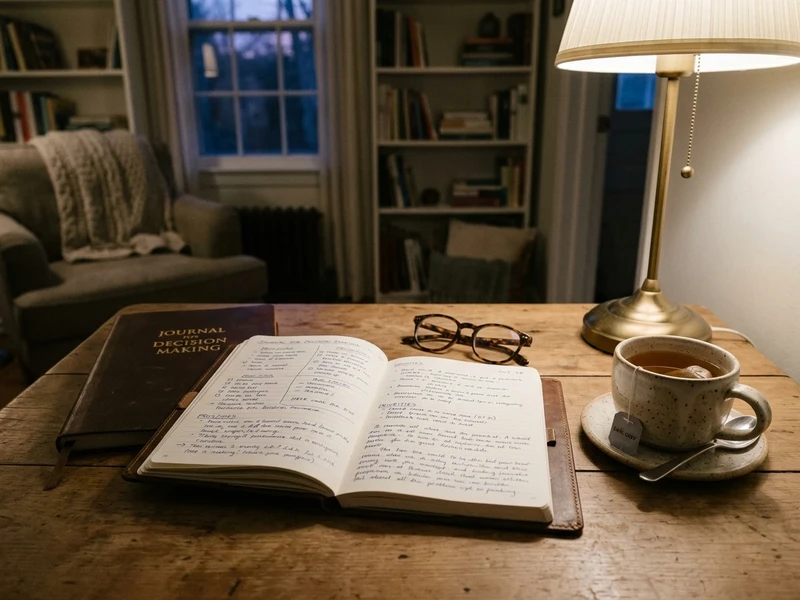
Prompts to Write Toward a Decision Without Forcing One
journal prompts for clarity write toward decision

Clarity doesn’t always arrive as a final answer, sometimes it arrives as a clearer version of the question.

  • What decision am I circling without actually making
  • What’s the real question underneath this decision, not just the surface one
  • What am I afraid the honest answer might be
  • What would I do if I trusted my own judgment completely on this
  • What does writing this out, even without a conclusion, make clearer than it was before I started

Let the Entry End Without a Tidy Conclusion

One of the more freeing parts of Didion’s own account is that she didn’t claim writing always resolved things neatly.

  • Allow an entry to end mid-thought if that’s genuinely where the clarity runs out for today
  • Resist forcing a neat, quotable conclusion just because the entry feels incomplete otherwise
  • Come back to an unresolved entry later, rather than assuming you failed to reach clarity in one sitting
  • Treat partial clarity as real progress, not a failed attempt at total clarity
  • Clarity Isn’t the Same as Certainty

    Many people avoid journaling because they expect every entry to end with a clear answer. Joan Didion’s writing suggests something different. Often, writing doesn’t hand you certainty—it gives you a better question, a more honest perspective, or a small piece of understanding that wasn’t available before you started.

FAQ: Journal Prompts for Clarity

No, and Joan Didion’s own account of her writing process suggests the opposite. Writing is often how clarity gets generated in the first place, not simply a record of thoughts you already had fully formed.

That’s normal and doesn’t mean the entry failed. Clarity sometimes arrives gradually across multiple entries, or as a clearer version of the question rather than a final answer.

Start with a small, specific detail that’s been sticking with you, even if you don’t know why, rather than trying to name the whole feeling at once. Following a specific detail often leads somewhere a vague, general prompt won’t.

Yes. Even Joan Didion described feeling like she “couldn’t think” before her writing helped her work through what she was actually seeing and feeling. Messiness at the start is often part of the process, not a sign it isn’t working.

Joan Didion didn’t sit down already knowing what she thought and simply transcribe it. She wrote her way into understanding, one specific, honest detail at a time, trusting that the clarity would show up somewhere in the process rather than requiring it upfront. Journal prompts for clarity work the same way. Start before you feel ready, follow the detail that’s actually sticking with you, and let the understanding arrive through the writing, not before it.

Similar Posts

Leave a Reply

Your email address will not be published. Required fields are marked *