
Journal Prompts for Emotional Awareness (Backed by Real Brain Research)

In 2007, UCLA neuroscientist Matthew Lieberman and his colleagues published a study in the journal Psychological Science that gave a real, measurable explanation for something people had long suspected worked, but couldn’t fully explain. Participants were shown photographs of faces expressing strong emotions while their brains were scanned. When they simply put the emotion into words, “angry,” “afraid,” the activity in their amygdala, the brain’s threat detection center, measurably decreased, while activity in the prefrontal cortex, the region responsible for reasoning and regulation, increased.
The finding has since been replicated across multiple studies and stimuli, real memories, anticipated stress, live stressors during the scan itself. The effect isn’t a light switch. Naming an emotion doesn’t make it disappear, the reduction in intensity is real but partial, not a cure. And it’s worth being precise about what this is and isn’t. Affect labeling, the technical term for this practice, is specifically a brief, precise act of naming, not the same as dwelling on or repeatedly analyzing a feeling. Researchers distinguish it clearly from rumination, which tends to have the opposite effect, keeping distress active rather than settling it.
That distinction is exactly why journaling is such a natural fit for this research. A journal entry that names what you’re actually feeling, specifically, briefly, honestly, is affect labeling in its most practical form. The prompts below are built around that same idea, helping you move from a vague, overwhelming feeling to something named and, according to the research, genuinely calmer to hold.
Why Naming a Feeling Actually Changes How It Feels
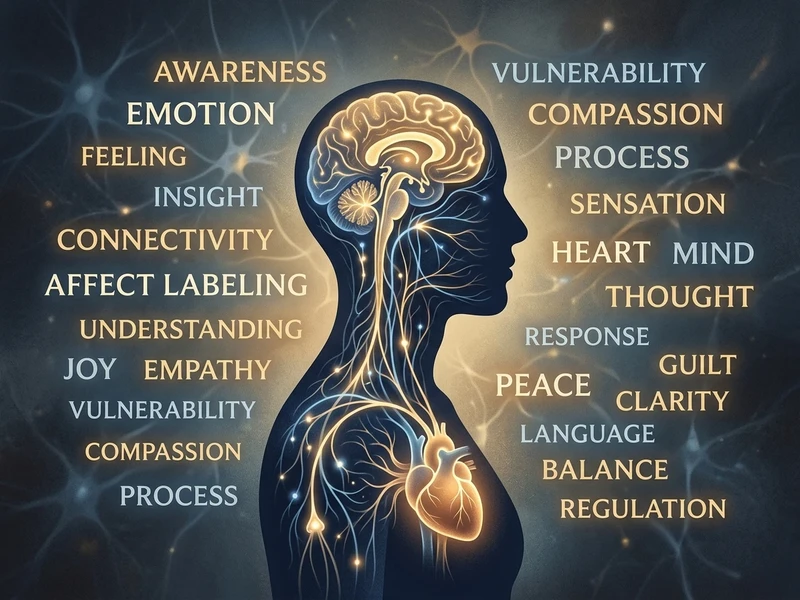
The mechanism behind this is worth understanding before using the prompts themselves.
Prompts to Simply Name What You’re Feeling

Start here, since precise naming is the actual mechanism the research points to.
Prompts to Explore Where the Feeling Came From
Once a feeling is named, understanding its source tends to make it easier to sit with.
Prompts for When a Feeling Feels Too Big to Name

Sometimes a feeling resists a single word, and these prompts help you get closer without forcing false clarity.
Prompts for Emotional Patterns Over Time

Individual entries help in the moment, but reviewing patterns across entries builds a different kind of awareness.
Prompts to Close an Entry With Intention
Ending an entry deliberately, rather than just stopping, tends to make the practice feel complete rather than left hanging.
FAQ: Journal Prompts for Emotional Awareness
Naming a feeling in a journal isn’t just a comforting ritual, it’s a practice with real, measurable support behind it. The goal was never to eliminate difficult emotions by writing about them. It’s to give yourself, and the more reasoning part of your brain, something concrete to work with instead of an overwhelming, unnamed feeling running the show. Start with one honest word, and let the rest of the entry follow from there.