
How to Prioritize Tasks (Starting With a Disputed Story Worth Knowing Anyway)

A story has circulated for years about Warren Buffett and his longtime personal pilot, Mike Flint. Buffett reportedly asked Flint to write down his top 25 career goals, then circle the five most important. When Flint said he’d focus mainly on the top five but still give the other 20 some attention along the way, Buffett is quoted as correcting him firmly. “No, you’ve got it wrong. Everything you didn’t circle just became your avoid-at-all-cost list.”
Here’s the honest part almost no version of this story includes. Several researchers and writers who’ve tried to trace its origin have found no solid documentation confirming it actually happened as described. It’s widely repeated, appears in dozens of respected productivity blogs, and gets attributed confidently to Buffett, but the real source is unclear enough that it’s fair to treat it as a business parable rather than a verified event.
That doesn’t make the lesson inside it any less useful, and it’s worth separating the two. Whether or not Buffett actually said those exact words to a real pilot, the underlying idea holds up on its own, and it happens to match something research on goal setting independently supports. A meta-analysis by psychologists Edwin Locke and Gary Latham, spanning decades of research, found that commitment and specificity, not the sheer number of goals you’re chasing, is what actually drives performance. In other words, the fictional or semi-fictional Buffett story and the real research arrive at the same place. Prioritizing isn’t really about identifying what matters. It’s about deliberately ignoring almost everything else.
Why Long To-Do Lists Quietly Sabotage Themselves

The core problem the Buffett story illustrates, real or not, is one worth taking seriously on its own.
Build Your Own Two-List System

Whether or not the original story is verified, the method itself is simple enough to actually use.
Separate Urgent From Important Before Prioritizing
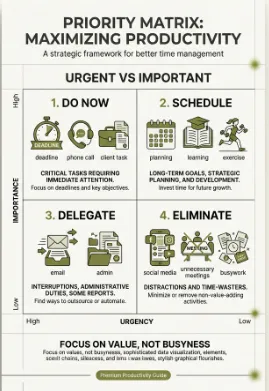
A task list often gets tangled because urgency and importance get treated as the same thing.
Use a Simple Scoring Method When a List Feels Too Close to Call

Not every task is obviously more important than another, and a simple scoring approach helps when everything feels equally pressing.
Protect Your Top Priorities Once You’ve Chosen Them
Choosing priorities is only half the work, the harder part is actually defending them once the list is set.
FAQ: How to Prioritize Tasks
Whether or not Warren Buffett ever actually said those exact words to his pilot, the idea behind the story holds up on its own, and real research on goal setting backs the same conclusion from a different direction. Prioritizing well isn’t about identifying more things that matter. It’s about choosing a short, honest list, and treating almost everything else as something you’re deliberately choosing to set aside, at least for now.