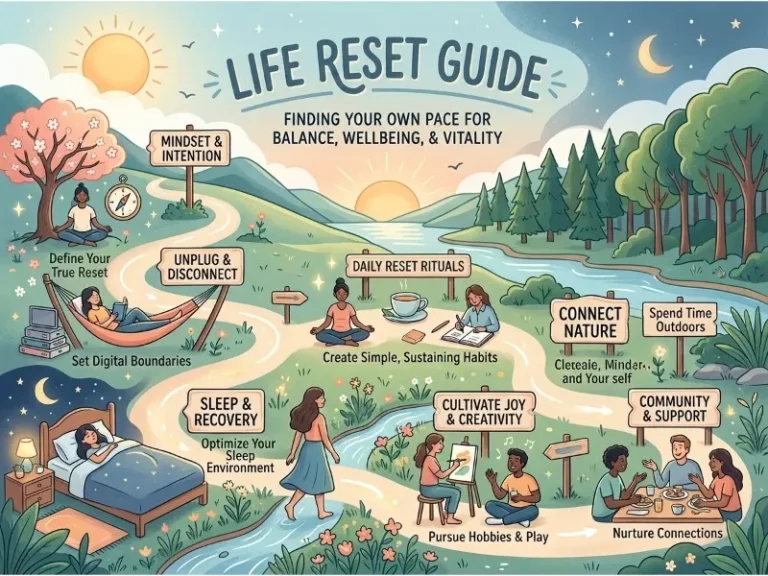
Self Care Routine: Simple Habits for Everyday Wellness

A self-care routine doesn’t have to mean spending an entire afternoon at a spa, following a complicated morning routine, or buying a shelf full of wellness products.
Sometimes self-care is much more ordinary.
Drinking enough water. Taking a proper break. Going outside for a few minutes. Putting your phone away before bed. Saying no when your schedule is already full. Going to sleep instead of trying to squeeze one more task into the day.
The idea behind self-care is not to create another demanding routine you have to maintain perfectly. It is to develop small habits that help you take care of your physical, emotional, and mental well-being.
And that means your self-care routine can look different from someone else’s.
If a 20-step morning routine makes you stressed, it isn’t necessarily self-care for you.
A useful routine should fit into your actual life.
This guide focuses on simple everyday self-care habits that are realistic enough to repeat, even when your day isn’t going perfectly.
What Is a Self-Care Routine?
A self-care routine is a collection of intentional habits and activities that support your well-being. It can include physical care, emotional awareness, rest, social connection, personal boundaries, and activities that help you feel more balanced.
Self-care is also more than something you do when you’re exhausted. Ideally, it becomes part of everyday life rather than an emergency response to burnout.
That doesn’t mean every day needs to look the same.
Some days your self-care might be a proper night’s sleep. Other days it might be taking ten quiet minutes alone, preparing a nourishing meal, calling someone you trust, or simply giving yourself permission to stop.
The most sustainable self-care routine is usually the one you can realistically maintain.
Why Simple Self-Care Habits Often Work Better
When self-care is presented as a long list of things you “should” be doing, it can start to feel like another productivity project. You wake up already thinking about meditation, exercise, journaling, skincare, meal preparation, hydration, reading, stretching, and an evening routine.
Then you miss half of it and feel as though you failed at self-care.
That defeats the purpose.
Simple habits are easier to repeat because they require less planning and less energy. Instead of trying to completely redesign your lifestyle, choose a few small actions that address what you genuinely need.
If you’re tired, prioritize rest. If you’re mentally overloaded, create some quiet. If you’ve been isolated, connect with someone. If you’ve been neglecting your body, give it basic care.
Self-care becomes more useful when you stop asking, “What should a perfect self-care routine look like?” and start asking, “What do I need today?”
Simple Morning Self-Care Habits

You don’t need to wake up at 5 a.m. to have a healthy morning routine. Your morning self-care can begin with something as basic as giving yourself a few minutes before immediately responding to notifications.
The purpose of a morning routine is not to accomplish as much as possible before breakfast. It is to create a calmer transition into your day.
Try choosing habits that help you feel awake, grounded, and prepared rather than rushed.
You don’t need to do all of these.
Choose one or two.
A morning routine becomes easier to maintain when it doesn’t require perfect circumstances.
Self-Care Habits for Your Physical Well-Being

Physical self-care often gets reduced to exercise and appearance, but it is much broader than that. Your body needs basic care every day, and those basics can have a bigger impact on how you feel than an elaborate wellness routine.
Think about the habits you tend to ignore when life becomes busy. Are you regularly skipping meals? Staying awake much later than you intended? Sitting for hours without moving? Going through the day without taking a proper break?
Your self-care routine can begin by addressing those basics.
The goal isn’t to create a perfectly healthy lifestyle overnight.
It is to stop treating your basic needs as optional.
Self-Care for Mental Wellness
Mental self-care is about giving your mind space to recover, process, and focus. Modern life can fill every quiet moment with notifications, entertainment, work, and information, leaving very little room for your brain to simply slow down.
Creating small periods of mental quiet can therefore become an important part of your routine.
You might spend ten minutes journaling, take a walk without listening to anything, read a few pages of a book, sit quietly with your morning drink, or simply stop consuming information for a while.
The activity doesn’t have to be productive.
Sometimes the point is precisely that it isn’t.
Emotional Self-Care Habits

Emotional self-care doesn’t mean staying positive all the time. In fact, constantly trying to replace difficult emotions with positive ones can sometimes prevent you from understanding what you are actually feeling.
Instead, emotional self-care can begin with acknowledging your emotions without immediately judging them.
You might ask yourself, “What am I feeling?” and then, “What might I need?”
Sometimes the answer will be practical. Sometimes you may simply need to allow yourself to feel disappointed, frustrated, sad, or overwhelmed without adding another layer of self-criticism.
Self-Care Through Healthy Boundaries

One of the most overlooked forms of self-care is protecting your time and energy.
You can sleep well, drink water, journal, and exercise regularly, but still feel exhausted if you are constantly saying yes to things you don’t have the capacity for.
A boundary doesn’t have to be dramatic. It can be as simple as saying, “I can’t do that today,” not answering messages immediately, protecting an hour of personal time, or deciding that you don’t need to explain every decision you make.
Healthy boundaries can feel uncomfortable at first, especially if you’re used to prioritizing everyone else’s needs.
But discomfort doesn’t automatically mean you’ve done something wrong.
Self-Care Doesn’t Always Look Relaxing

This is one of the most important things to understand about self-care.
Self-care isn’t always candles, face masks, cozy blankets, and quiet music.
Sometimes self-care looks like doing the uncomfortable thing that will make your future life easier.
Making an appointment you’ve been avoiding. Cleaning the space that has been stressing you out. Having a difficult conversation. Asking for help. Preparing food instead of skipping another meal. Going to bed instead of scrolling. Setting a boundary. Deleting an app that consistently makes you feel worse.
Rest can absolutely be self-care, but so can responsible action.
The question isn’t whether an activity looks relaxing.
The question is whether it genuinely supports your well-being.
A Simple Daily Self-Care Routine
If you want something practical to start with, keep your daily routine small. Think of it as a foundation rather than a complete wellness program.
Morning:
During the day:
Evening:
You don’t have to complete every habit every day.
Think of these as options rather than requirements.
A Weekly Self-Care Reset

Daily habits are useful, but once a week it can help to step back and look at the bigger picture.
Instead of simply repeating the same routine, ask yourself whether the routine is actually supporting you.
This weekly check-in can prevent your self-care routine from becoming automatic. Your routine should evolve as your circumstances change.
How to Create a Self-Care Routine That Actually Fits Your Life
Start with your current life rather than an imaginary version of it.
If you have ten free minutes, build a ten-minute routine. If your mornings are chaotic, don’t create a 90-minute morning ritual that requires perfect silence and uninterrupted time.
Look for small gaps that already exist.
Maybe you can take five minutes after lunch. Maybe evenings are quieter. Maybe you can journal while having your morning coffee. Maybe your version of self-care is simply putting your phone away for thirty minutes.
Then choose habits according to your actual needs.
If you’re exhausted, don’t add ten more tasks. If you’re lonely, don’t respond by creating an elaborate solo routine. If you’re overwhelmed, simplify. If you’re bored and disconnected from yourself, make room for something enjoyable.
Self-care becomes sustainable when it is designed around your life rather than forcing your life to fit around it.
Signs Your Self-Care Routine Needs to Change
A routine that once worked for you may eventually stop working. That doesn’t mean you failed. It simply means your needs changed.
You may need to reconsider your routine if it constantly feels like another obligation, takes more energy than it gives back, leaves no room for flexibility, or makes you feel guilty when you miss a habit.
Your routine may also need adjustment if you are using “self-care” to avoid responsibilities that genuinely need attention.
The goal is balance.
Self-care should support your life, not become another thing you have to escape from.
FAQ: Self-Care Routine
A self-care routine doesn’t need to look impressive.
It doesn’t need to fill your morning with ten different wellness habits or turn your evening into a carefully optimized ritual.
It simply needs to help you take better care of yourself.
Start with the basics. Sleep when you need rest. Eat when you’re hungry. Move your body. Take breaks. Spend time with people who matter. Protect your boundaries. Make room for things you enjoy.
And pay attention to what your mind and body are actually asking for.
Some days, self-care will mean doing less.
Other days, it will mean finally doing something you’ve been avoiding.
Neither is more correct.
The most useful self care routine is not the one that looks best on social media.
It’s the one that makes your everyday life a little more sustainable, supportive, and yours.