
30 Day Self-Care Challenge: A Simple Daily Plan

30 day self care challenge

Most 30 day challenges fail by day six. Not because people lack willpower, but because the challenge itself was built for someone with more free time than they actually have. A self-care challenge that asks for an hour a day is really just a guilt generator with a calendar attached.

This one is built differently. Each day asks for one small thing, usually five to fifteen minutes, that adds up to a real shift in how you feel by day thirty. You are not trying to overhaul your life in a month. You are trying to prove to yourself that small, repeated attention to your own wellbeing is worth keeping around after day thirty ends.

Why Most Self-Care Challenges Don’t Stick

Search “30 day self-care challenge” and you’ll find lists that ask for a bath one day, a digital detox the next, then a full skincare routine, then journaling, then a random act of kindness. Nothing wrong with any single item. The problem is sequencing. Big asks on day one lead to quiet quitting by day four. The version below groups days into four themes: noticing how you actually feel, building tiny structure, reconnecting with people, and locking in whatever worked so it survives past day thirty. Each week builds on the last instead of throwing a new unrelated task at you every morning.

Week 1: Noticing

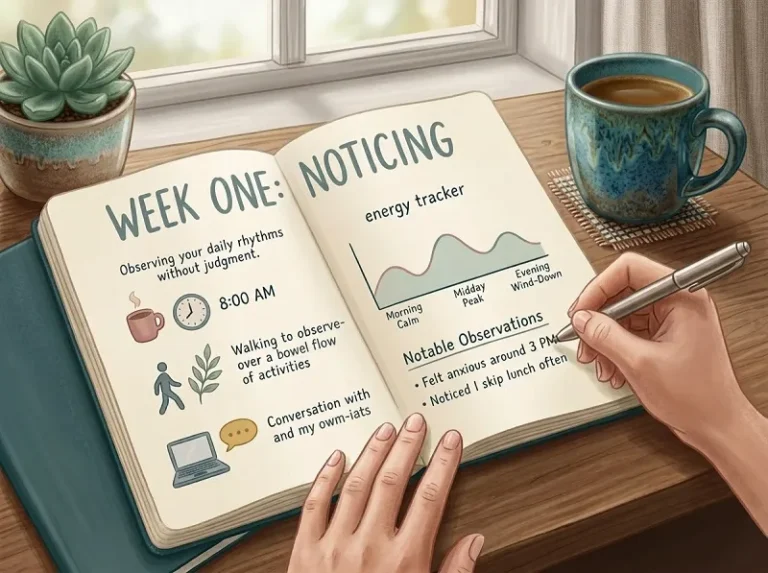
The first week isn’t about adding anything dramatic. It’s about paying attention to what your days already look like, since most people start a self-care challenge without actually knowing where their time and energy go.

  • Spend five minutes each morning naming how you feel before checking your phone
  • Track your sleep and energy levels without changing anything yet
  • Notice which parts of your day drain you and which restore you
  • Write down one thing you’re avoiding and why
  • Sit with a drink without doing anything else for ten minutes
  • Take a short walk with no podcast or music
  • Ask yourself honestly what self-care actually means to you

By the end of week one you should have a clearer picture of your actual baseline, not the one you assume you have.
Pause & reflect

Week 2: Small Structure

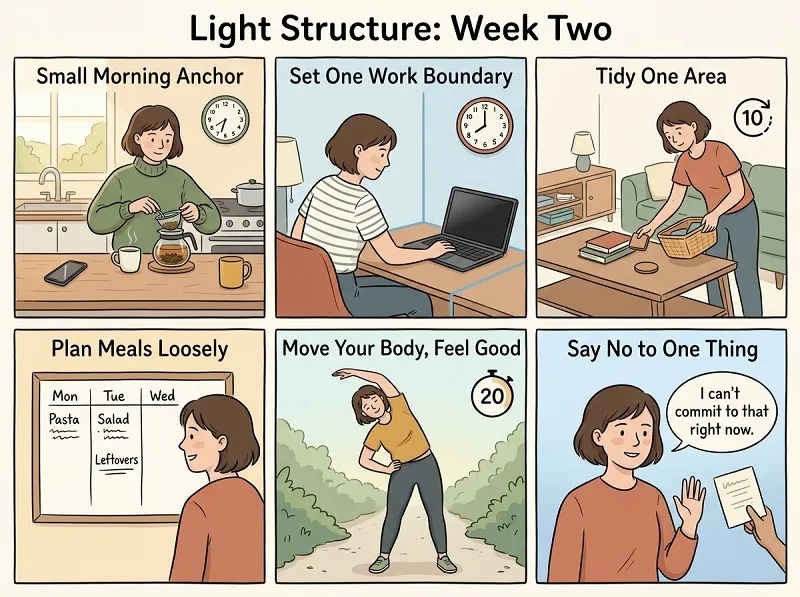
Once you know where your energy actually goes, week two adds light structure around the gaps you noticed.

  • Pick one small morning anchor, like making tea before touching your phone
  • Set one boundary around work hours, like no email after 8pm
  • Tidy one area of your home for ten minutes
  • Plan meals loosely for the next few days instead of deciding under pressure
  • Move your body in a way that feels good, not punishing, for twenty minutes
  • Say no to one thing that doesn’t serve you
  • Take a proper break at lunch instead of eating at your desk

None of this is glamorous. It’s also the part that actually changes how your weeks feel, since most stress comes from a lack of small structure rather than a lack of big gestures.
Adding_structure_to_your_week

Week 3: Connection

Self-care gets marketed as something you do alone, which is only half true. Isolation quietly makes most people feel worse, even introverts who genuinely need solitude to recharge.
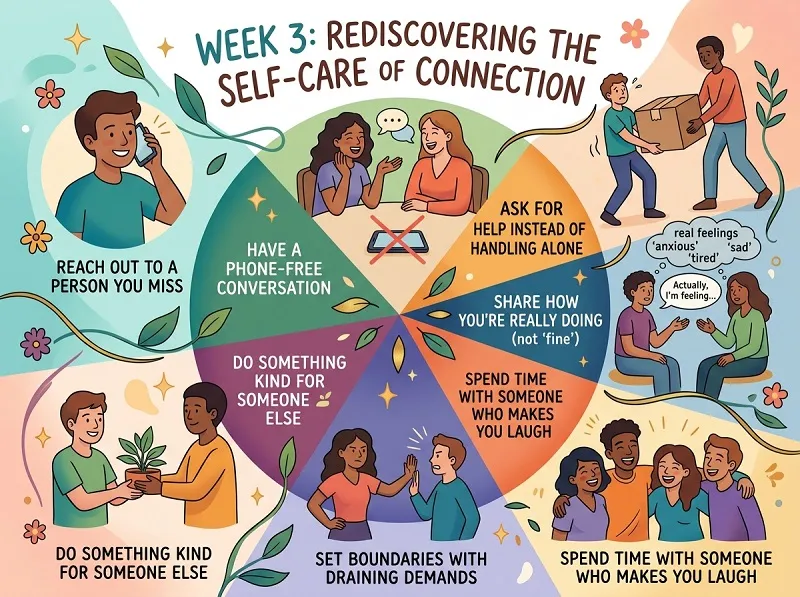
  • Reach out to one person you’ve been meaning to talk to
  • Have one conversation without your phone nearby
  • Ask someone for help with something instead of handling it alone
  • Share how you’re actually doing instead of saying fine
  • Spend time with someone who makes you laugh without trying
  • Set a boundary with someone whose demands have been draining you
  • Do something kind for someone else
Connection

Week 4: Keeping It Going

The final week shifts from adding new habits to deciding what actually deserves to survive past day thirty.

  • Review which of the past three weeks’ habits made a real difference
  • Drop anything that felt like an obligation rather than a relief
  • Write down your three most valuable habits from the month
  • Plan how you’ll keep those three going without the challenge structure
  • Reflect on what surprised you most about the past month
  • Do one thing purely for enjoyment, no productivity angle attached
  • Celebrate finishing, even quietly
self care challenge
  • How to Actually Finish This One

    Most people fail 30 day challenges for the same avoidable reason.
    They treat every day as equally important, so missing one day feels
    like failing the whole month. Missing a day is normal. Restart the
    next morning instead of waiting for a new Monday.
    Keep a simple record instead of relying on memory. A basic notes app,
    a paper calendar, or an app like Day One works fine here since the
    point is consistency, not the tool itself. Do the day’s task at
    roughly the same time daily so it stops requiring willpower. If a
    day’s suggestion genuinely doesn’t fit your life, swap it for
    something in the same spirit rather than skipping it entirely.

A Simple 30 Day Self-Care Checklist

If you want the condensed version to print or save, here’s the shape of the whole month in one list.

  • Notice your baseline energy and mood before changing anything
  • Add one small morning anchor and repeat it daily
  • Set one boundary around your time or attention
  • Tidy or plan something small each day, not everything at once
  • Reconnect with at least three people you’ve been meaning to talk to
  • Say no to something that drains you without guilt
  • Review each week and keep only what genuinely helped
  • Pick your top three habits to carry past day thirty

FAQ: 30 Day Self-Care Challenge

No. The four week themes build on each other loosely, but if a specific day doesn’t fit your week, move it. The goal is completing the month, not following the exact sequence.

Pick back up where you left off instead of restarting from day one. A challenge you finish imperfectly beats a perfect start you abandon by week two.

Most days ask for five to fifteen minutes. If even that feels like too much some days, do a shortened version rather than skipping entirely.

Related but different. A self-care Sunday routine is a weekly reset. This challenge is a month long attempt to build several small habits at once, some of which may turn into your ongoing Sunday routine afterward.

Thirty days from now, the specific tasks on this list will matter far less than whichever three or four habits you decide to keep. That’s the actual point of a challenge like this. It’s not the month itself. It’s what you choose to carry forward once the calendar runs out.

Similar Posts

Leave a Reply

Your email address will not be published. Required fields are marked *